Humboldt Forum
Back to all places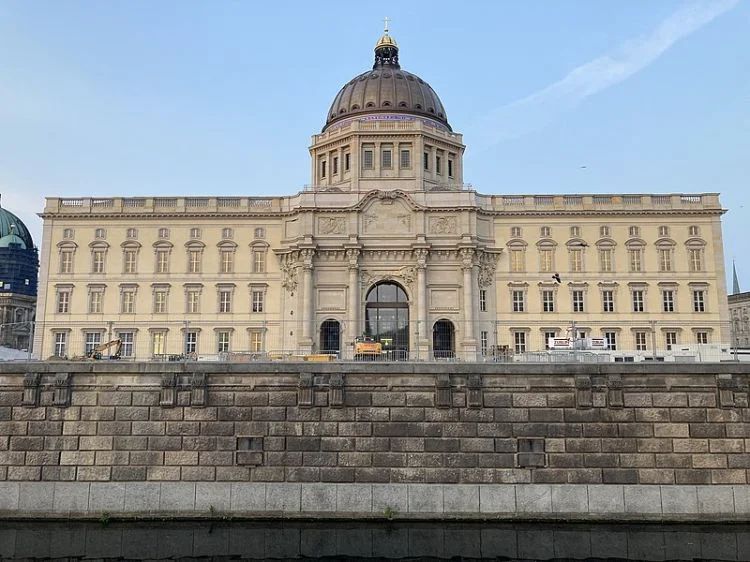
The new Humboldt Forum in Berlin Mitte extends over an area of around 30,000 square metres and is visible from afar. The reconstructed baroque palace façades on the northern, southern and western sides of the Forum shine in bright quince yellow. The eastern side of the Forum on the banks of the Spree is surprising: a modern, smooth exterior façade, with the “Spree balcony” viewing platform in front and a large terrace just above the surface of the water on the riverbank. The architecture of the Humboldt Forum clearly thrives on a contrasting combination of ultra-modern building elements and the reconstructed sculptural façades of Berlin’s former Baroque palace. The creator of this particular design and architect of the Humboldt Forum is the Italian architect Franco Stella. He won the competition for the reconstruction in 2008.
The interior of the Humboldt Forum opened in July 2021: An impressive foyer on the ground floor connects high-rise modern gallery walls with the reconstructed palace portal. This is where the “cosmographer”, a 17-metre-high media tower and quick-change artist, stands: it will not only radiate information, but can transform at any time into a gigantic art and light installation. In the sculpture hall on the ground floor, the original sandstone figures of the castle façades can be viewed close up. And on the southern side of the Humboldt Forum, a 28-metre-long video panorama is on display, vividly illustrating the historical development of the site – since the earliest dated evidence from the 12th century. Visitors can really immerse themselves in the history of the location in the palace cellar, where the remains of the medieval Dominican monastery and the foundations of the palace have been uncovered.
On the first floor of the completely wheelchair-accessible building, the Berlin exhibition offers a surprising special view of Berlin: And it’s not only global developments that have influenced and shaped Berlin that come into focus here. It also asks what impact Berlin has had on the world and what inspirations emanated from this city – and it does this interactively with the help of its visitors. Imaginative media and the World Studio, where personal experiences are shared, present the city as part of a diverse and globally-networked community. Science and cutting-edge research on global challenges – not from a distance, but up close and tangible: the new Humboldt Laboratory, a project of Berlin’s Humboldt University, is a workshop for all those who want to take part in the process of scientific research and discuss global problems and challenges: Climate change, environmental destruction, species extinction and major societal issues. Right at the entrance to the Humboldt Laboratory, visitors are immersed in the world of research via the large model of a school of fish, symbolic of collective intelligence.
Chinese court art, richly decorated houses from Oceania or a throne from the Kingdom of Bamum/Cameroon - around 20,000 aesthetically outstanding exhibits from the 5th millennium B.C. to the present day have been presented on 16,000 square metres on the second and third floors of the Humboldt Forum: in the Ethnological Museum and the Museum of Asian Art. But the unique artefacts do not only present the fascinating traditions of other cultures. A new curation method also addresses the circumstances under which they were taken from indigenous communities and the dilemma of the actors on the ground, in short: the difficult history of colonialism and the role of Europe with its after effects felt up to the present day.
In September 2022, the last large exhibition area of the museums also opened in the East Wing. Here, collection presentations on North, Central and South America can be seen, as well as another part of the object collection on Asia and Africa with highlights such as the exhibition area on the global diversity of Islam and the historical Kingdom of Benin. New and unusual: the exhibitions also feature the positions of contemporary artists who either directly refer to the objects on display or deal with them. Also unusual are the sound installations in a special elliptical listening room, which were created on the basis of ethnomusicological research.
https://www.visitberlin.de/en/humboldt-forum
Photo: Ernstol
52.51728, 13.40164