Konzerthaus Berlin
Back to all places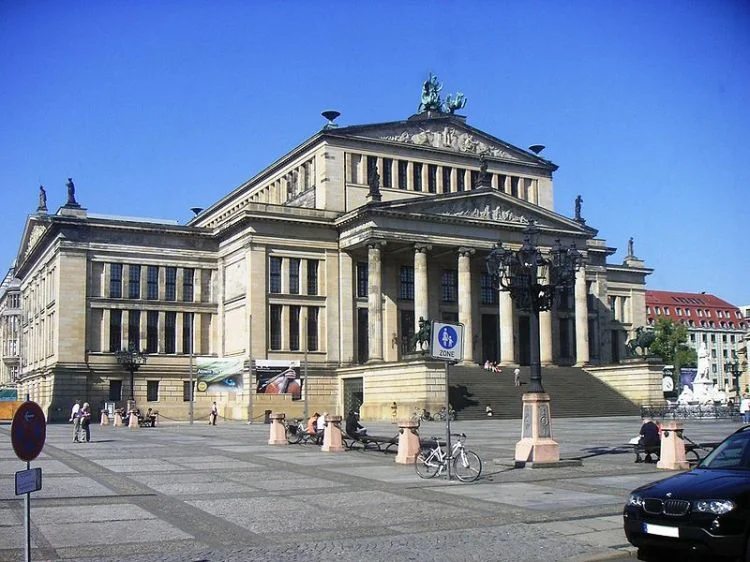
The Berlin Concert Hall was originally a theatre: it was built at the request of Frederick the Great in the 18th century as a French comedy house. At the beginning of the 19th century, the architect Carl Gotthard Langhans planned a new, more ornate building. However, this only lasted 15 years. After a fire, the theater was rebuilt in 1821 by what is probably Berlin’s most famous architect, Karl Friedrich Schinkel.
The house has experienced many great evenings: In 1789, Wolfgang Amadeus Mozart attended the performance of his opera The Abduction from the Seraglio. Schinkel’s stage design adorned the opera Undine by ETA Hoffmann. Paganini and Franz Liszt gave guest performances. Richard Wagner conducted The Flying Dutchman. When the Konzerthaus was still a theater, corner seat number 23 in the stalls belonged to Theodor Fontane, who reviewed the pieces – and also liked to tear them down.
Bombs destroyed the theater in World War II, it burned down to the foundations. The house was not reopened until 1984 – now as a concert hall. Since then, great conductors and orchestras have performed here. After the fall of the Berlin Wall, Leonard Bernsteinv conducted Beethoven’s Ninth with an international orchestra and transformed the text of the chorus into the Ode to Freedom.
The exterior of the house is a detailed reconstruction of Schinkel’s old playhouse. The interior, on the other hand, has been redesigned, but furnished in a classical style. It’s worth letting your eyes wander in the large hall at the concert and enjoying the white and gold decor. The large organ with 74 registers and a total of 5,811 pipes is an eye-catcher. There is also the Apollo Hall for smaller concerts, a music club and the modern Werner Otto Hall.
https://www.visitberlin.de/de/konzerthaus-berlin
Photo: Philipp Wetzlar
52.51364, 13.39179